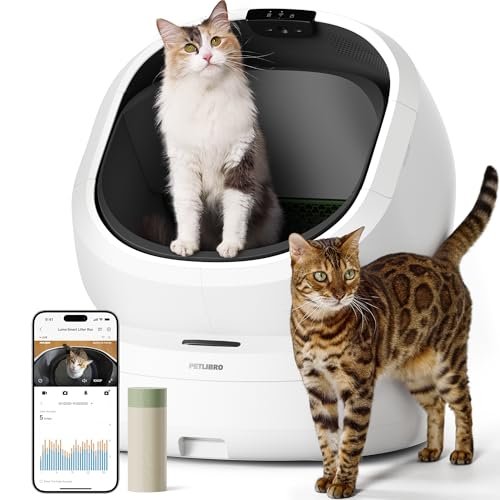
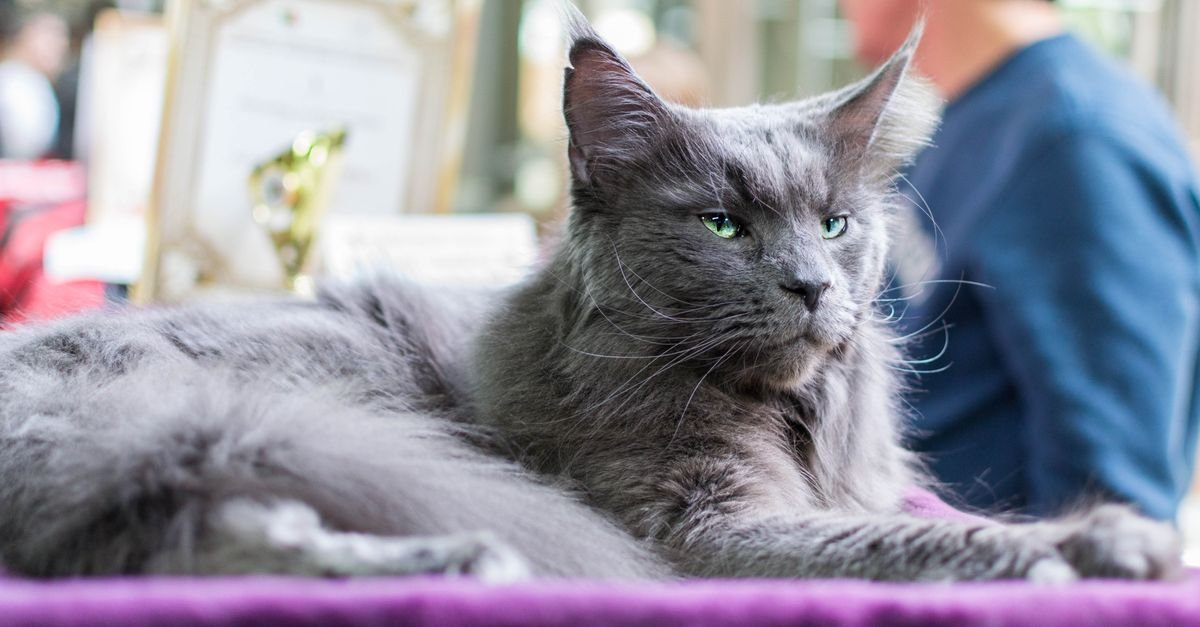
A weight limit is reassuring, but it does not tell you whether a large cat will actually like using an automatic litter box. A 20-pound cat can be compact and broad; another cat at the same weight can be long-bodied, tall through the shoulders and reluctant to turn around inside an enclosed globe. If I were shopping for a Maine Coon, Norwegian Forest Cat or simply a big domestic cat, I would pay more attention to body length, entry geometry and usable interior space than to the number printed beside “maximum cat weight.”
For a large cat, the best automatic litter box is not simply the model with the highest weight rating. Check whether your cat can enter without ducking awkwardly, stand in a normal posture, turn around, dig and leave without squeezing through a narrow opening. Manufacturer weight ranges matter for sensors and safe operation, but comfort is a body-size problem as much as a weight problem.
The shopping trap is treating pounds as a measurement of space
Automatic litter-box pages often give you a cat-weight range because the machine needs to detect the animal reliably and because its safety system is designed around certain operating limits. That number is useful. It just answers a different question from the one most owners think it answers.
Suppose a machine is rated for cats up to 25 pounds. That tells you the manufacturer expects the system to work within that range. It does not tell you how much room your particular 24-pound cat has between its nose, hips and tail when it turns around inside the drum. Nor does it tell you whether a tall cat has to crouch under the roof or whether a broad cat brushes both sides of the opening every time it enters.
Traditional litter-box guidance makes the underlying issue easier to see. The Feline Veterinary Medical Association guidance on litter-box size notes that many cats prefer a box about one and a half times the length of their body. I would not use that figure as a rigid pass-or-fail formula for an automatic machine—the geometry is different—but it is a useful reminder that length matters. A product can technically support a cat’s weight while still giving it less room than the cat would choose in an open tray.
That is why I would measure the cat before measuring the spot where the machine will go. Measure from the nose to the base of the tail when the cat is standing naturally. Notice shoulder height. Watch how much room the cat uses when it turns in its current box. Those observations tell you more about likely comfort than breed name alone.
The doorway tells you how the cat gets in; it does not tell you how the cat lives inside
Entry dimensions are one of the most useful specifications for a large cat, especially with enclosed automatic boxes. A wide opening reduces the feeling of squeezing into a machine, and height matters for cats that do not like crouching. But I would resist turning entry size into another single-number shortcut.
Whisker currently lists the Litter-Robot 4 entryway at 15.75 by 15.75 inches and says the model is intended for cats from 3 to 25 pounds. The same Whisker's current Litter-Robot 4 specifications also gives an interior height of 16.5 inches when discussing large-cat fit. Those numbers are much more informative together than the 25-pound limit on its own.
Open-top machines approach the same problem differently. Neakasa describes the M1 as suitable for cats from about 2.2 to 33 pounds and lists an entry height of 13.86 inches, while its main selling point for fit is the absence of a closed roof over the toileting area. You can see the current details on the Neakasa's current M1 specifications. PetSafe likewise says its open-top ScoopFree OpenSky accommodates cats up to 33 pounds; the PetSafe's current OpenSky specifications emphasizes open movement rather than an enclosed globe.
I am not using those examples to declare a winner. They show why “large-cat compatible” can mean different things. One design gives you a large circular doorway into a contained interior. Another removes the roof and lets a tall cat keep more of its normal posture. Whether that matters depends on how your cat already uses a litter box.
If your cat currently avoids covered boxes, spends time circling before eliminating, or keeps its head and shoulders high while digging, an open-top design deserves serious consideration. If your cat already uses a covered box comfortably and you care more about containing litter or visually enclosing the waste area, a roomy globe may be perfectly reasonable. You can compare open-top automatic litter boxes on Amazon, but I would use the listings to compare geometry rather than assuming “open” automatically means spacious.
Watch the cat you already have instead of imagining the cat in the product photo
Product photography is not a sizing tool. Wide-angle lenses make interiors look generous, and the cat in the marketing image may be much smaller than yours. Before buying, spend a few minutes watching your cat use its existing tray. The small details are surprisingly useful.
Does your cat step in, turn once and squat? Does it scratch at several corners before choosing a spot? Does it keep its rear close to the wall? Does it stand half in and half out? Does it perch on the rim? A cat that uses very little space may adapt to an enclosed robot more easily than a cat that has a long, deliberate turning routine even if both cats weigh exactly the same.
This is also where “large” can be misleading. Some heavy cats need more floor area because of body width. Some long-bodied cats need more turning radius. A tall, lean cat may care more about roof height than floor width. I would rather match the machine to that behavior than rely on a breed label.
Mark the proposed entry width and interior footprint with painter’s tape or cardboard near your cat’s current litter area. You are not recreating the machine, but the exercise makes dimensions tangible and often reveals whether a doorway that looked “huge” on a product page is actually close to your cat’s shoulder width.
For a big cat, the easiest entry can matter more with age
Large cats are not necessarily mobility-limited, but a large senior cat can make access more important than capacity. A high lip, awkward step or steep approach may be fine for a young athletic cat and annoying a few years later. If your cat already hesitates before jumping into a high-sided box, I would not assume the convenience of automatic scooping will compensate for a harder entrance.
International Cat Care's home-modification guidance recommends easy access and a low side for cats with mobility problems. That guidance is about ordinary litter trays, but the principle transfers cleanly: the path into the toilet should not become the hardest part of using it.
This does not mean every large cat needs a ramp. It means the approach deserves the same scrutiny as the interior. Some automatic boxes sit relatively low. Others are tall enough that a manufacturer sells a step or ramp as an accessory. If you think access will matter, compare the machine’s floor-to-entry height and the footprint of the step as a single system. A “compact” robot can become considerably less compact once the access step is in front of it.
You can compare litter-box steps and access ramps on Amazon if you need an idea of the available step and ramp styles, but fit is better judged against the exact litter-box model and your cat’s mobility than against a generic accessory description.
Sensor limits are a safety specification, not a comfort score
Weight still matters, particularly at the low end. Automatic boxes use combinations of weight sensors, infrared sensors, lasers or other detection systems to decide when a cat has entered and when a cleaning cycle can safely begin. That is why manufacturers publish minimum weights or special kitten modes.
For a large adult cat, the more relevant lesson is not “higher maximum equals better.” It is to stay within the manufacturer’s stated range and then evaluate comfort separately. A 33-pound maximum does not prove that every 30-pound cat will enjoy the usable space, just as a 25-pound maximum does not prove a 20-pound long-bodied cat will feel cramped.
I also would not use app-based weight tracking as a reason to squeeze a cat into a machine it dislikes. Weight trends can be a useful convenience, but the litter box first has to function as a place the cat willingly uses. If adoption is poor, the smartest sensor package in the world does not fix the core problem.
The usable litter bed is easy to overlook
External dimensions can be misleading with automatic litter boxes because motors, waste drawers, rotating shells and internal chutes take up space. A machine that occupies a large patch of floor can still have a relatively modest litter surface. For large cats, that distinction is worth looking for in manuals, dimension diagrams and owner photos.
I care less about the total liters of litter the machine can hold than about the shape of the area where the cat actually stands. Is there a flat, stable bed? Is the surface deep enough for the litter you use? Can the cat dig without repeatedly hitting a wall or flexible liner? Does the cat have enough room to choose a spot instead of being forced into one posture?
This is one reason I would keep the old litter box available during the transition. If the cat repeatedly chooses the old tray, that is information. It may be habit, it may be the sound of the new machine, or it may be that the old tray simply gives the cat more room. Removing the familiar alternative too quickly makes it harder to learn what the cat is telling you.
Large-cat fit can also change the maintenance side of the equation
A bigger cat generally produces bigger clumps and more waste than a small cat. That does not automatically require a different machine, but it can shorten the real interval between drawer changes. “Up to two weeks” or “up to eight days” is usually based on a particular household scenario, not a promise for every cat.
If your cat is large and the waste drawer is small, the convenience benefit may be less dramatic than the headline suggests. I would read drawer capacity claims with the same skepticism I apply to battery-life claims: useful for comparison, but dependent on real use. The question is not whether the machine can hold waste. It is how often your cat is likely to fill it.
The same goes for litter tracking. A large cat stepping out of a tall opening can launch more litter than the tidy product photo suggests. A generous landing mat, a well-positioned step and enough clear floor around the entrance may matter more than an app notification telling you the litter level is low.
What I would compare after the size question is settled
Once I am confident the cat can use the machine comfortably, then I would compare the features automatic-litter-box shoppers usually start with: how the safety system works, what litter is compatible, whether the drum or tray can be deep-cleaned without a miserable amount of disassembly, how easy waste bags are to replace, whether filters or liners are proprietary, and what happens when Wi-Fi is unavailable.
Those details still matter. They just should not rescue a machine that is physically wrong for the cat. A beautiful app, excellent odor control and a huge waste drawer are benefits for the person. Adequate space and easy access are benefits for the animal actually using the toilet.
For a broader look at those trade-offs, our guide to choosing an automatic litter box covers safety, cleaning, litter compatibility and running costs in more detail.
There is no shame in choosing a large conventional box instead
Automatic litter boxes solve a human chore. They are not automatically an upgrade for every cat. If the models that fit your home do not give your cat enough room, a very large conventional litter box can be the better choice even though it requires scooping.
That is especially true if your large cat already has a strong preference for an open, oversized tray. The point of automation is to make litter care easier without making toileting worse. If achieving both goals requires a physically larger robot than your home can accommodate, the honest answer may be that the trade-off does not work in that room.
If you are ready to compare current models, you can browse automatic litter boxes for large cats on Amazon. I would open the promising listings in separate tabs, ignore the star rating for the first pass, and write down four things: stated cat-weight range, entry dimensions, usable interior dimensions or design, and floor-to-entry height. Those four details will eliminate more poor fits than most feature lists.
A large cat needs usable space, not just permission from the weight limit.
Start with the cat’s body and behavior. Weight limits tell you whether the machine is designed to detect and operate around a cat in that range; entry size, interior geometry and access tell you whether the cat is likely to use it comfortably. If those two sets of numbers point in different directions, I would trust the fit problem before the feature list.