Raised beds make watering look simple until you try to keep several rows evenly moist without soaking paths, hand-watering every evening or discovering that the far end of a hose barely gets wet. Drip irrigation and soaker hoses both move water closer to the roots than a sprinkler, but they solve the job in different ways. The better choice depends less on which one is marketed as more efficient and more on how much control, setup work and maintenance you want.
A soaker hose is usually the easier entry point for one or two compact raised beds with fairly dense planting. It is inexpensive, simple to snake through a bed and requires little planning. Drip irrigation takes more parts and setup, but it gives you more control over where water is delivered, scales better across multiple beds and is easier to tune for plants with different spacing or water needs. If your garden changes every season, simplicity may matter more than precision. If the system is becoming permanent, drip becomes easier to justify.
Both systems are low-volume irrigation, but they do not distribute water the same way
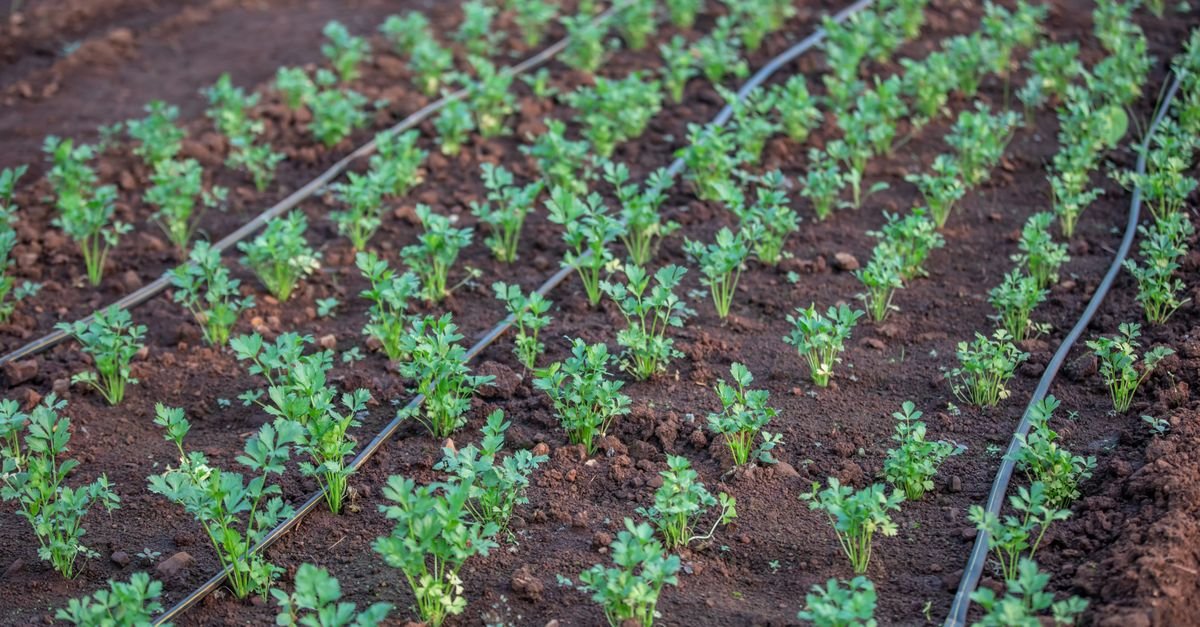
The useful distinction is the way water leaves the line. A soaker hose is porous along much of its length, so water seeps through the hose wall and wets a continuous strip of soil. Drip irrigation uses tubing with individual emitters or built-in emitter spacing, allowing water to be released at specific points or intervals.
The U.S. EPA groups drip systems under microirrigation: low-pressure, low-flow irrigation that applies water close to the root zone. EPA notes that microirrigation can reduce runoff and evaporation compared with conventional spray irrigation and reports water savings of roughly 20% to 50% versus conventional sprinkler systems. That is useful context, but it does not mean a drip line automatically uses 50% less water than a soaker hose. Both can be efficient when they are sized, scheduled and maintained well.
A soaker hose wins the first-hour setup test
For a gardener who wants to stop standing with a watering wand, the appeal of a soaker hose is obvious. Connect it to a hose bib or leader hose, lay it along the planting rows, pin it in place and turn the water on. University of Nevada Extension describes soaker hoses as beginner-friendly because water seeps along the hose directly toward the root zone.
That simplicity is especially useful in a single 4-by-8-foot bed or a pair of beds close to the faucet. There are fewer fittings to understand, and the hose can be repositioned when tomatoes become fall greens or a dense row of carrots replaces widely spaced peppers.
Think dense rows, temporary layouts and small gardens. If the hose can cover the bed with one or two short runs and you are happy to check soil moisture manually, a complicated emitter system may solve a problem you do not have.
Drip irrigation asks for more planning because the components are doing specific jobs
A basic drip system may include a filter, pressure regulator, main tubing, smaller distribution tubing, emitters, tees, end caps and stakes. That sounds like overkill next to one porous hose, but those pieces are what give the system control.
EPA’s technical guidance says microirrigation systems should include components such as pressure regulation, filtration and a way to flush the lines. A current Rain Bird drip-kit installation diagram likewise puts a mesh filter and pressure regulator directly after the faucet before the small tubing and emitters. Those parts are not decorative. Small emitter passages can clog, and drip equipment is designed to operate at lower pressure than a typical unrestricted hose connection.
The payoff is that you can decide where water is applied. A tomato can receive an emitter near its root zone while the empty soil between widely spaced plants stays comparatively dry. In a bed with permanent berries, trellised vegetables or shrubs, that control can be more useful than the extra simplicity of a hose that wets everything along its path.
Uniformity is the biggest reason to think twice about a long soaker hose
Soaker hoses are easy to install, but water does not always leave them evenly from beginning to end. Colorado State University Extension recommends keeping soaker-hose or soaker-tube runs relatively short—generally around 25 feet or less—for more uniform delivery. It also notes that longer lines can deliver more water near the beginning and less near the end, especially when the ground is not level.
That matters in raised beds because a system that looks wet at the faucet end can leave the opposite corner drier than expected. If you are using one hose across several beds in series, the problem becomes easier to create.
Drip systems can have their own pressure and flow problems, but pressure-compensating emitters are specifically designed to deliver a more consistent flow across a range of pressures. EPA recommends pressure-compensating drip where elevation, topography or pressure changes are significant.
Plant spacing should influence the choice more than the shape of the box
A raised bed is rectangular, but the plants inside it may not be. Lettuce, carrots and beans can form dense rows where a continuous wetted strip is useful. Tomatoes, zucchini, peppers or perennial herbs can be spaced much farther apart.
University of Florida IFAS describes drip tubing with evenly spaced outlets as a good long-term choice for regularly spaced plants, while soaker hoses are a simpler and often less expensive choice for temporary or irregular layouts. The more empty soil there is between plants, the more valuable point-by-point control becomes because you can avoid deliberately watering space where roots are not using much moisture.
This does not mean every raised bed needs a separate emitter for every plant. Inline drip tubing with emitters at fixed intervals can split the difference: simpler than individual spaghetti tubing, but more predictable than water seeping from an entire porous hose.
Soaker hoses can be easier to move, but they are not maintenance-free
The low-tech appearance of a soaker hose can make it feel maintenance-free. It is not. University of New Hampshire Extension warns that mineral deposits, sand and other debris can gradually clog soaker hoses and reduce flow. The failure can be subtle because the hose still looks connected and still feels damp in some places.
That is why I would uncover or inspect the hose periodically rather than burying it and forgetting about it. Run the system, look for dry sections and check soil moisture at more than one point in the bed.
Drip lines need the same habit in a different form. Filters need cleaning, laterals may need flushing, and individual emitters can clog or become dislodged. The advantage is that a failed emitter is often a local problem. The disadvantage is that there are more small parts to inspect.
Do not bury either system so deeply that you cannot tell whether it is working
Covering irrigation with mulch is useful because it reduces evaporation and protects tubing from sunlight. Deep burial is a different choice. An Ask Extension response from Oregon State’s network recommends keeping soaker hoses close enough to the surface that they can be inspected, with light cover or mulch for protection.
That is a sensible ownership rule for either system in a home garden. A hidden irrigation line is aesthetically tidy, but troubleshooting gets harder when a dry plant is the first sign that the line has failed.
Multiple raised beds change the economics of the decision
One bed can be watered with almost anything. Four or six beds make distribution the real problem. You now need to think about how water reaches each box, whether all beds run at once, whether one bed contains thirstier crops and whether a line can be shut off when a bed is empty.
A soaker-hose setup can still work, especially with a manifold or faucet splitter and one short hose per bed. The system stays understandable, but the number of hoses and connections grows quickly.
Drip systems scale more cleanly because a main line can feed multiple laterals, and valves can divide beds into zones. That takes more effort up front, but the finished system behaves more like infrastructure than a collection of garden hoses.
A timer helps both systems, but automation does not fix bad distribution
A hose-end timer can make either system more convenient. It can water early in the morning, stop a long slow cycle automatically and keep your garden from depending on whether you remember the hose before work.
What a timer cannot do is make an uneven soaker hose even, unclog an emitter or know that last night’s rain already supplied enough moisture unless you add more advanced controls. EPA’s WaterSense program notes that weather-based and soil-moisture-based controllers can reduce unnecessary irrigation by adapting schedules to weather or measured soil moisture.
For a small raised-bed garden, I would add automation in stages: first make sure the physical distribution is even, then add a basic timer, and only then decide whether weather or soil-sensing automation solves a real inconvenience.
How to choose without turning this into an irrigation engineering project
| Buying question | Soaker hose | Drip irrigation |
|---|---|---|
| Fastest setup? | Usually simpler | More parts and planning |
| Dense rows? | Very practical | Inline drip also works well |
| Widely spaced plants? | Waters more empty soil | Emitters can target individual plants |
| Several beds? | Works, but hose management grows | Easier to build into zones |
| Uneven terrain or long runs? | Uniformity becomes harder | Pressure-compensating options help |
| Seasonal reconfiguration? | Easy to move | Modular, but more fittings to change |
| Maintenance? | Watch for clogging and uneven seepage | Clean filters, flush lines and inspect emitters |
A five-minute pre-buy checklist
- Measure the number of beds and the distance from the faucet to each one.
- Decide whether plants are densely row-planted or widely spaced.
- Check whether the garden is level or whether beds sit at different elevations.
- Decide whether the layout changes every season or is becoming permanent.
- If choosing drip, include a compatible filter and pressure regulator in the budget.
- If choosing soaker hose, plan short runs rather than one very long hose through every bed.
- Make sure the system remains accessible enough to inspect and flush.
- After installation, check soil moisture at the beginning, middle and end of the bed before trusting the timer.
The better system is the one you can verify, adjust and maintain
I would choose a soaker hose for a compact garden where low setup effort matters most and the beds contain fairly continuous planting. I would choose drip when the garden has multiple beds, wider plant spacing, permanent plant locations or enough complexity that targeted watering and zoning will save work later.
Neither choice eliminates the need to look at the soil. The University of Nevada Extension recommends checking watering depth rather than assuming that a long run time means roots actually received enough moisture. That remains the most useful reality check after every specification and diagram.
If you are building a broader home-and-garden setup, the BestByNeed Buying Guides hub organizes other decision-first guides by category. If you already know the constraints but not the product type, describe them in the BestByNeed Finder—for example, “four raised beds, uneven spacing, hose faucet, want automatic morning watering”—and start from the need instead of from a brand list.
Use a soaker hose when simplicity is the feature; use drip when control is the feature.
Both systems can keep raised beds productive without spraying water across leaves and paths. A soaker hose is easier to deploy and easy to rearrange. Drip irrigation asks for more planning, filtration and pressure control but rewards that effort with more predictable placement and better scalability. The right choice is the one whose setup and maintenance still make sense after the garden doubles in size or the planting plan changes next spring.
References checked for this guide: EPA WaterSense microirrigation guidance, University of Nevada Extension vegetable-garden irrigation, Colorado State University Extension, UF/IFAS DIY microirrigation guidance, and University of New Hampshire Extension.