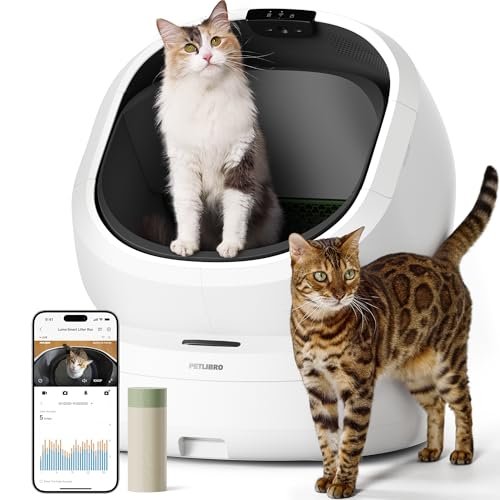
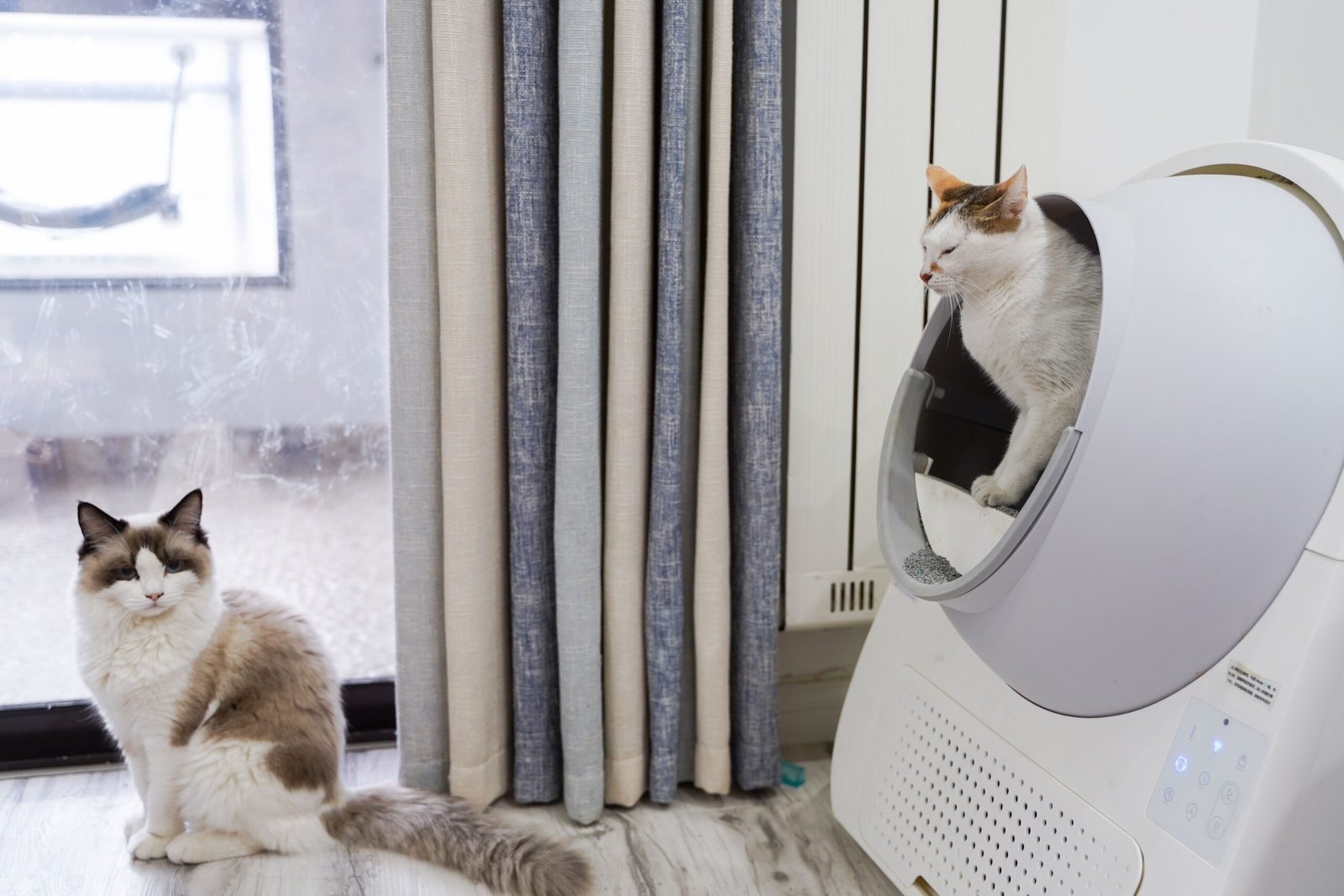
A smart litter box can look completely dependent on its app because setup screens, alerts, cleaning history and cat-weight data all live on your phone. But the more useful buying question is simpler: what happens when the connection disappears—or the power does? Those are two very different failures, and treating them as the same thing can lead to the wrong purchase.
Many automatic litter boxes can continue their core cleaning routine when Wi‑Fi goes down because their local sensors and preset settings still operate on the machine itself. A power outage is different: without electricity, the motor cannot cycle unless the model has a supported backup battery or another approved power solution. When comparing models, separate internet independence from power resilience.
Wi‑Fi loss and power loss are not the same failure
It helps to think of an automatic litter box as four layers: the physical toilet, the local sensors and controls, the app/cloud connection, and the power supply.
If Wi‑Fi disappears but household power remains on, the machine may still be fully capable of detecting a cat and running the cleaning program already stored on the device. What you lose may be remote controls, notifications, usage history or live status. If household power disappears, however, the motor, sensors and electronics usually stop unless the product includes or supports backup power.
This distinction is already hinted at in the broader BestByNeed automatic litter box buying guide, but it deserves its own decision because connected features have become a major part of how these machines are sold.
Ask two separate questions before purchase: “Will it still clean without internet?” and “Will it still clean without mains power?” A yes to the first does not imply a yes to the second.
Some current models are designed to keep cleaning without Wi‑Fi
Manufacturer guidance shows that at least some established models keep core cleaning logic locally rather than requiring a live cloud connection for every cycle.
| Model | What the manufacturer says about losing network access | What the buyer should take from it |
|---|---|---|
| Litter-Robot 4 | Whisker says the unit does not require Wi‑Fi for normal use and will continue to cycle automatically after each visit; app features such as phone notifications are the part that disappear. | Core cleaning can remain local even when the connected layer is unavailable. |
| PETKIT PuraMax 2 | PETKIT says the machine continues operating according to preset settings when the network connection is lost, while app usage data stops updating. | Preset behavior matters: configure the machine while it is online, then understand which settings continue locally. |
That does not mean every smart litter box behaves this way. It also does not mean every app feature is cosmetic. Remote fault alerts, drawer notifications and usage history can be genuinely useful, especially if the box jams while you are away. The point is that internet dependence should be verified at the function level rather than inferred from the presence of an app.
Offline operation is only useful if the important settings live on the device
Suppose a machine keeps cycling after your router goes down. That is reassuring, but the next question is whether you can still control the settings you care about locally.
Look for physical buttons or documented local controls for manual cleaning, reset, emptying and power. Then check which behavior is stored on the machine: cleaning delay, sleep periods, do-not-disturb windows, kitten protection or other safety modes.
A connected product can be perfectly reasonable even when some advanced options remain app-only. The problem is when a basic household task becomes impossible because the cloud is unavailable. If the cat has used the box and you are standing beside the machine, you should know whether you can initiate or stop a cycle without reaching a server somewhere else.
A power outage changes the problem completely
Once electricity is gone, the fact that a machine can work without Wi‑Fi no longer helps. The rotating globe, rake, sensors and control board still need power.
Whisker is unusually explicit about this distinction for Litter-Robot 4. Without backup power, the machine will not function during an outage. The company sells a rechargeable backup battery that automatically takes over when household power is interrupted and is rated for roughly 24–48 hours of operation depending on use.
Whisker also documents the compromises in battery mode: Wi‑Fi and the night light are disabled to conserve energy, and the display brightness is reduced. That is a useful example of what “backup power” should mean in a product specification. It should explain not only that the machine stays on, but which features are intentionally shut down to extend runtime.
Do not assume another automatic litter box accepts a generic battery, power bank or uninterruptible power supply just because the plug physically fits. Motors can have startup loads, voltage requirements and safety expectations that are not obvious from the connector. If outage resilience matters, use only a manufacturer-approved backup method or a solution the manufacturer explicitly supports.
Backup power matters more for some households than others
A short outage while you are home may be little more than an inconvenience. You can keep the box available as a conventional toilet and manually scoop if needed. The calculation changes when outages are frequent, you travel often, or the litter robot is the only toilet in the home.
For a multi-cat household, waste can accumulate much faster during a long outage. Our guide to automatic litter boxes for multiple cats explains why drawer capacity and back-to-back use already compress service intervals; a power failure compresses them further because waste remains in the litter bed instead of being moved into the drawer.
For a senior cat, kitten or cat with a strong preference for one box, removing the robot from service can create another problem: the backup toilet may be less accessible or less familiar. The practical resilience plan is therefore not just electrical. It is also behavioral.
The best outage backup is still a conventional litter box
Even if you buy a battery-supported model, keeping an ordinary litter tray available is the most robust fallback. It does not need firmware, Wi‑Fi, electricity or a motor, and it gives you somewhere to direct the cat while the automatic unit is rebooting, being repaired or deep-cleaned.
This does not undermine the value of automation. It simply recognizes that a litter box is a critical household resource. BestByNeed already recommends keeping an alternative during transitions, and the same logic applies to outages.
If your cat is older or has mobility limits, the backup should not be a random high-sided tray stored in a closet. Our senior-cat automatic litter box guide explains why entry height and access matter. A fallback only counts if the cat can actually use it comfortably.
What happens when power comes back?
Recovery behavior is another specification worth checking. A machine may reboot, reconnect and resume normal operation automatically—or it may require attention.
The useful questions are practical: does it remember the cleaning delay? Does it reconnect to Wi‑Fi on its own? Does it know whether a cycle was interrupted? Will it immediately start moving after power returns, or wait for a sensor check? Is there an obvious ready-state indicator on the control panel?
This matters because an outage can end while nobody is watching. A safe design should have a documented startup sequence rather than leaving the owner to guess what the machine will do when electricity returns.
Cloud features can fail even when your home network is fine
There is a third failure mode between “Wi‑Fi is down” and “power is down”: your router works, but the manufacturer’s cloud service or app does not.
If the machine’s core cycle logic is local, that outage may have little effect on cleaning. But remote alerts, history and settings could still become unavailable. This is why a buyer should not ask only whether the product supports Wi‑Fi. Ask what happens if the manufacturer app is temporarily unavailable—or eventually discontinued.
For long-lived household appliances, local controls age better than cloud promises. A machine that remains a functional litter box without its app has a more graceful failure mode than one whose basic behavior depends on continuous service availability.
A practical offline-resilience checklist
- Without Wi‑Fi: Does automatic cleaning continue from locally stored settings?
- Without the app: Can you start, stop or reset a cycle from the control panel?
- Without power: Is there a manufacturer-supported backup battery or approved alternative?
- In battery mode: Which features are disabled to extend runtime?
- After restoration: Does the machine resume safely and reconnect automatically?
- During a long outage: Is there a conventional backup tray the cat already accepts?
- For travel: Can another caregiver understand the local controls without your phone?
The most resilient automatic litter box is not necessarily the one with the fewest connected features. It is the one that degrades gracefully: app features can disappear without taking the toilet with them, and a power interruption has a clear backup plan.
Who should care most about offline operation?
If your internet connection is unreliable, put local operation high on the list. If your electricity is unreliable, prioritize backup power and a conventional fallback. If you are away from home for long stretches, both matter because the person solving a problem may not be you.
For everyone else, offline resilience is still worth checking because it reveals how dependent the product is on the connected ecosystem. You may never experience a long outage, but you will eventually reboot a router, change Wi‑Fi credentials, replace a phone or encounter an app problem.
If you are comparing models now, use the BestByNeed Finder to start with the constraints that matter in your home, then open the relevant product pages to verify current connectivity, control and safety details before purchase.
Wi‑Fi independence and power resilience are two different features.
A well-designed smart litter box can lose its internet connection and keep doing the basic job. Losing electricity is another matter: unless there is supported backup power, the automatic part stops. Before buying, verify what continues locally, what depends on the app, what happens after an outage, and whether your cat has a usable conventional fallback when the technology is unavailable.
Manufacturer references checked for this guide: Whisker Litter-Robot 4 connectivity guidance, Whisker Litter-Robot backup battery, and PETKIT PuraMax 2 product guidance.