A dishwasher can save time in a small apartment, but the wrong format can create a new space problem. A countertop model takes over valuable work surface. A full-size portable model preserves the counter but needs floor space, a route to the sink and somewhere to park when it is not running. The useful comparison is not simply “small versus large.” It is which inconvenience fits your kitchen better.
Choose a countertop dishwasher when you have enough counter space, wash smaller daily loads and want the appliance to stay close to the sink. Choose a portable rolling dishwasher when you need much more rack capacity and can give up floor or storage space instead. If your faucet is difficult to adapt, a countertop model with a built-in water tank can remove the faucet connection from the fill side, although it still needs a place to drain.
The real trade-off is counter space versus floor space
Small kitchens rarely have unused space; they just have different kinds of space. A countertop dishwasher may be only around 17 inches wide, but that footprint can occupy the exact section of counter you use for food prep, a coffee maker or a drying rack. Moving it after every cycle is possible, but even compact models can weigh around 30 pounds before you think about hoses and residual water.
A portable dishwasher shifts that burden to the floor. Whirlpool describes portable dishwashers as typically around 24 inches wide, 27 inches deep and 37 inches high. Its current WDP370PAHB comparison lists a 12-place-setting capacity, which is much closer to a conventional full-size dishwasher than to a tiny countertop machine.
This is the first question I would answer with a tape measure: which is harder to sacrifice in your kitchen, roughly a microwave-sized section of counter or a dishwasher-sized rectangle of floor/storage space?
A rolling dishwasher does not disappear when the cycle ends. Measure where it will live when disconnected, the path to the sink and the clearance needed to open its door. Small-space appliances should be judged in both their working position and their storage position.
Capacity is where the two formats stop being interchangeable
“Compact” does not mean one universal capacity. ENERGY STAR classifies compact dishwashers as models holding fewer than eight place settings plus six serving pieces, while standard-capacity models meet or exceed eight place settings. That is a useful dividing line because it explains why two machines that both avoid permanent cabinetry can support very different routines.
Danby’s current DDW631SDB countertop model is rated for six place settings. HAVA’s smaller R09 is rated for three place settings. By contrast, Whirlpool’s current portable WDP370PAHB is listed for 12 place settings. Those numbers are manufacturer-defined capacities, but the direction is clear: a rolling portable unit can handle a household-sized load that would require multiple runs in a small countertop machine.
| Buying question | Countertop dishwasher | Rolling portable dishwasher |
|---|---|---|
| Best fit | One or two people, frequent smaller loads | Larger loads without permanent installation |
| Space cost | Countertop | Floor/storage space |
| Typical capacity example | About 3–6 place settings in current examples | 12 place settings in Whirlpool’s current portable example |
| Water connection | Faucet quick-connect or built-in tank, depending on model | Usually faucet quick-connect while running |
| Large cookware | Often limited by rack height and door size | Much more practical for full dinner loads and larger pieces |
A countertop unit can be plumbing-light without being plumbing-free
Countertop models come in two broad water-supply styles. Danby’s DDW631SDB uses a quick-connect system compatible with most kitchen faucets. HAVA’s R09 offers either a faucet inlet or a 5-liter built-in tank that you fill manually. That second design is attractive in rentals because the machine can receive water without staying connected to the faucet.
But a tank does not make the entire wash cycle independent of the sink area. Wastewater still has to go somewhere, usually through a drain hose positioned into a sink or another suitable drain container according to the manufacturer’s instructions. You are removing one connection step, not eliminating water management.
Manual filling also becomes part of the routine. If you run the machine once a day, pouring in a tank of water may feel trivial. If you run several cycles after cooking for guests, repeated filling can make a faucet-fed machine more attractive.
Faucet compatibility can decide the purchase before capacity does
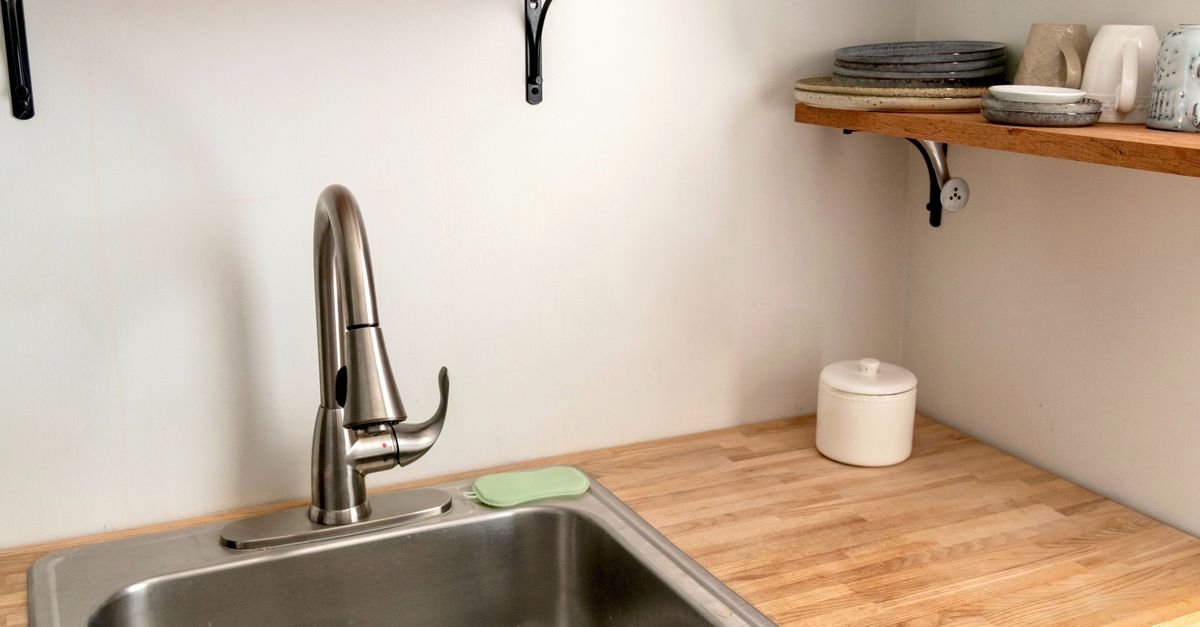
Portable dishwashers commonly use an aerator adapter and quick-connect hose. GE’s current support guidance says its portable dishwasher adapter is designed for standard faucet spouts with internal or external threads. The dishwasher connects to the faucet while washing, and the same assembly handles the incoming hot water and draining back into the sink.
That sounds simple until your faucet is not a conventional threaded spout. Pull-down spray heads, unusual aerators and proprietary faucet designs can make adapters difficult or inappropriate. I would check the exact faucet and the dishwasher manual before ordering, not after a 100-pound appliance is in the kitchen.
A built-in-tank countertop model is one way around the fill-side compatibility problem. Another is choosing a countertop quick-connect model only after confirming its adapter fits your faucet. Do not assume “fits most faucets” means “fits mine.”
The sink is partly occupied while a faucet-connected machine runs
A portable dishwasher is convenient precisely because it borrows the kitchen faucet temporarily. The trade-off is that the faucet is not fully available for ordinary sink use during the cycle. That can be annoying in a small kitchen where one sink already has to handle rinsing food, filling pots and hand washing.
Countertop models with faucet feeds create a similar conflict. Tank-fed models reduce it because the faucet does not need to remain attached for the water supply, although the drain hose may still occupy part of the sink area.
This sounds like a small detail until you cook while the dishwasher is running. Daily workflow matters more than whether the connection takes thirty seconds.
Large plates and cookware are the hidden limit of countertop machines
Place-setting counts are useful, but the shape of your dishes matters just as much. A compact rack can wash several plates and mugs efficiently while still being awkward for a stockpot, tall cutting board or oversized dinner plate.
HAVA currently says its R09 can take dishes up to about 10.24 inches. That is enough for many standard plates but tells you why rack dimensions deserve attention. A portable full-size dishwasher has a much better chance of swallowing cookware along with the dinner dishes rather than forcing you to hand-wash the largest pieces.
If your sink is currently dominated by pots and pans rather than cereal bowls and coffee cups, capacity should probably outweigh the smaller footprint.
More cycles can erase some of the efficiency advantage of a small machine
Compact dishwashers can use very little water per cycle. Current ENERGY STAR criteria cap certified compact models at 2.0 gallons per cycle and standard models at 3.2 gallons per cycle. The important catch is capacity: ENERGY STAR also notes that compact machines may use more energy over time if their smaller racks force a household to run more cycles.
That is why I would compare water and energy per useful load, not just per cycle. A very efficient countertop machine is a strong fit when one load covers the day’s dishes. If dinner regularly turns into two or three compact cycles, a larger portable machine may be the more sensible workflow even if each individual cycle uses more resources.
Noise is model-specific, not automatically a win for either format
Small does not necessarily mean quiet. Danby lists the DDW631SDB at 54 dB, while Whirlpool lists the WDP370PAHB portable model at 64 dBA. Those are examples, not a rule that every countertop machine is quieter than every portable one.
In a studio apartment, noise matters more because the kitchen may be only a few feet from a desk, sofa or bed. Read the actual decibel rating of the model and think about when you will run it. A louder machine that finishes one large evening load may still be less disruptive than a quieter compact unit running twice.
The best small-space appliance is the one you do not have to rearrange the room to use
Small-space buyers often focus on the dimensions of the appliance and ignore the choreography around it. A countertop dishwasher needs loading space in front of it and may displace another appliance. A portable dishwasher needs a rolling path, sink access and a place to sit afterward.
This is the same reason a self-empty robot-vacuum dock can be more or less valuable depending on the room it consumes. Our guide to whether a self-empty dock is worth paying for makes the same broader point: convenience hardware still has a physical footprint.
Before buying a dishwasher, simulate the routine with a cardboard footprint or tape on the floor. Open the nearby cabinet doors. Stand where you would load it. Imagine the hose across the sink. If the layout becomes irritating before the machine even exists, the specification sheet will not fix it.
A practical apartment checklist
- Measure available counter width, depth and overhead cabinet clearance.
- Measure a permanent or temporary parking spot for a rolling portable model.
- Check the largest dinner plate, pan and cutting board you expect to wash.
- Verify the faucet aerator and adapter requirements before purchase.
- Decide whether losing faucet access during a cycle will disrupt cooking.
- Count how many real daily loads your household would create at the advertised capacity.
- Check noise rating if the kitchen shares space with sleeping or working areas.
- Confirm the drain-hose route, outlet location and manufacturer installation requirements.
If counter space is abundant but floor space is scarce, start with countertop. If counter space is precious and you need full-size capacity, start with portable. If neither space is easy to sacrifice, the right answer may be an 18-inch built-in or continuing with manual washing until the kitchen changes.
Which type fits which household?
I would favor a countertop dishwasher for one person or a couple who create a modest daily load, have a stable piece of counter near the sink and mainly want plates, bowls, cups and utensils automated. A built-in water tank becomes especially useful when faucet compatibility is uncertain or you do not want the faucet tied up for filling.
I would favor a rolling portable dishwasher when the household regularly fills a conventional dishwasher load, cooks with larger pans or cannot spare permanent counter space. It makes more sense when there is a clear place to park the machine and a standard faucet connection is easy to reach.
If you want to compare other decision-first guides rather than generic “best product” lists, browse the BestByNeed Buying Guides. You can also use the BestByNeed Finder for product categories already modeled around specific constraints.
Choose the dishwasher format around the space you can afford to lose.
A countertop dishwasher is not automatically the best small-apartment choice simply because the machine itself is smaller. It can consume the most valuable work surface in the room. A portable dishwasher is much larger, but it can deliver near full-size capacity without permanent cabinet installation. Measure the counter, the floor, the sink connection and the real dishes you use. The format that creates the least daily friction is usually the better small-space purchase.
References checked for this guide: ENERGY STAR dishwasher criteria, ENERGY STAR dishwasher buying guidance, GE portable dishwasher faucet guidance, Danby DDW631SDB specifications, HAVA R09 specifications, and Whirlpool dishwasher comparison.