Air purifier shopping gets confusing the moment two machines advertise wildly different room sizes even though their airflow looks similar. One box says 400 square feet. Another says 1,800. A third promises more than 2,000. The missing detail is usually how often the purifier is expected to clean that amount of air. Room size means very little until you connect it to CADR, air changes per hour and the volume of the space.
For particle filtration, start with smoke CADR, not the largest square-foot number on the product page. AHAM’s practical rule is a smoke CADR at least two-thirds of the room area for a typical 8-foot ceiling. That works out to roughly five air changes per hour. Increase capacity for high ceilings, open floor plans or unusually heavy particle loads, and remember that CADR tells you about particle-cleaning throughput—not how well a thin carbon sheet will remove gases or odors.
Why one purifier can honestly have several “room size” numbers
A purifier does not suddenly stop cleaning when a room becomes one square foot larger than the recommended area. It simply takes longer to cycle the room’s air through the filter. That is why the same machine can be marketed for a smaller room at a high cleaning rate and a much larger room at a lower one.
The current Blueair Blue Pure 311i Max is a good example. Blueair lists a recommended room size of 439 square feet at 4.8 air changes per hour, while also saying the unit can clean 2,107 square feet in one hour. Those statements describe different turnover rates, not different hardware.
Levoit does something similar with the Vital 200S-P: the manufacturer lists 388 square feet at 4.8 ACH and 1,862 square feet at 1 ACH, alongside a CADR of 250 CFM. Again, the large number is not false. It is simply a much slower cleaning rate.
If a purifier claims a surprisingly large coverage area, look for the ACH assumption or the time interval. “Cleans 1,800 sq ft in one hour” is a different promise from “sized for 400 sq ft at about five air changes per hour.”
CADR is the number that makes room-size claims comparable
Clean Air Delivery Rate, or CADR, is the volume of filtered air a purifier delivers. AHAM reports separate CADR values for smoke, dust and pollen because different particle sizes behave differently. For sizing a purifier around fine particles, smoke CADR is the most useful starting point.
The U.S. EPA’s home air-cleaner guidance recommends choosing a portable purifier with a CADR large enough for the room and notes that the rating is typically measured at the unit’s highest speed. EPA’s sizing table uses an 8-foot ceiling and lands close to the same relationship as AHAM’s rule.
AHAM’s 2/3 rule is easy to use: choose a smoke CADR that is at least two-thirds of the room’s square footage. A 300-square-foot room therefore calls for roughly 200 CFM of smoke CADR as a baseline.
| Room area | Baseline smoke CADR | Assumption |
|---|---|---|
| 150 sq ft | About 100 CFM | Typical 8-ft ceiling |
| 200 sq ft | About 133 CFM | Typical 8-ft ceiling |
| 300 sq ft | About 200 CFM | Typical 8-ft ceiling |
| 400 sq ft | About 267 CFM | Typical 8-ft ceiling |
| 500 sq ft | About 333 CFM | Typical 8-ft ceiling |
This is a sizing shortcut, not a guarantee about every pollutant or room. Doors, furniture, airflow patterns, particle sources and filter loading all change real-world performance. The value of the rule is that it gives you a common baseline before marketing language enters the comparison.
ACH explains what the purifier is doing with that CADR
Air changes per hour describes how many room-volumes of cleaned air the purifier can theoretically deliver in an hour. The basic relationship is straightforward: CADR in cubic feet per minute multiplied by 60, divided by the room volume in cubic feet.
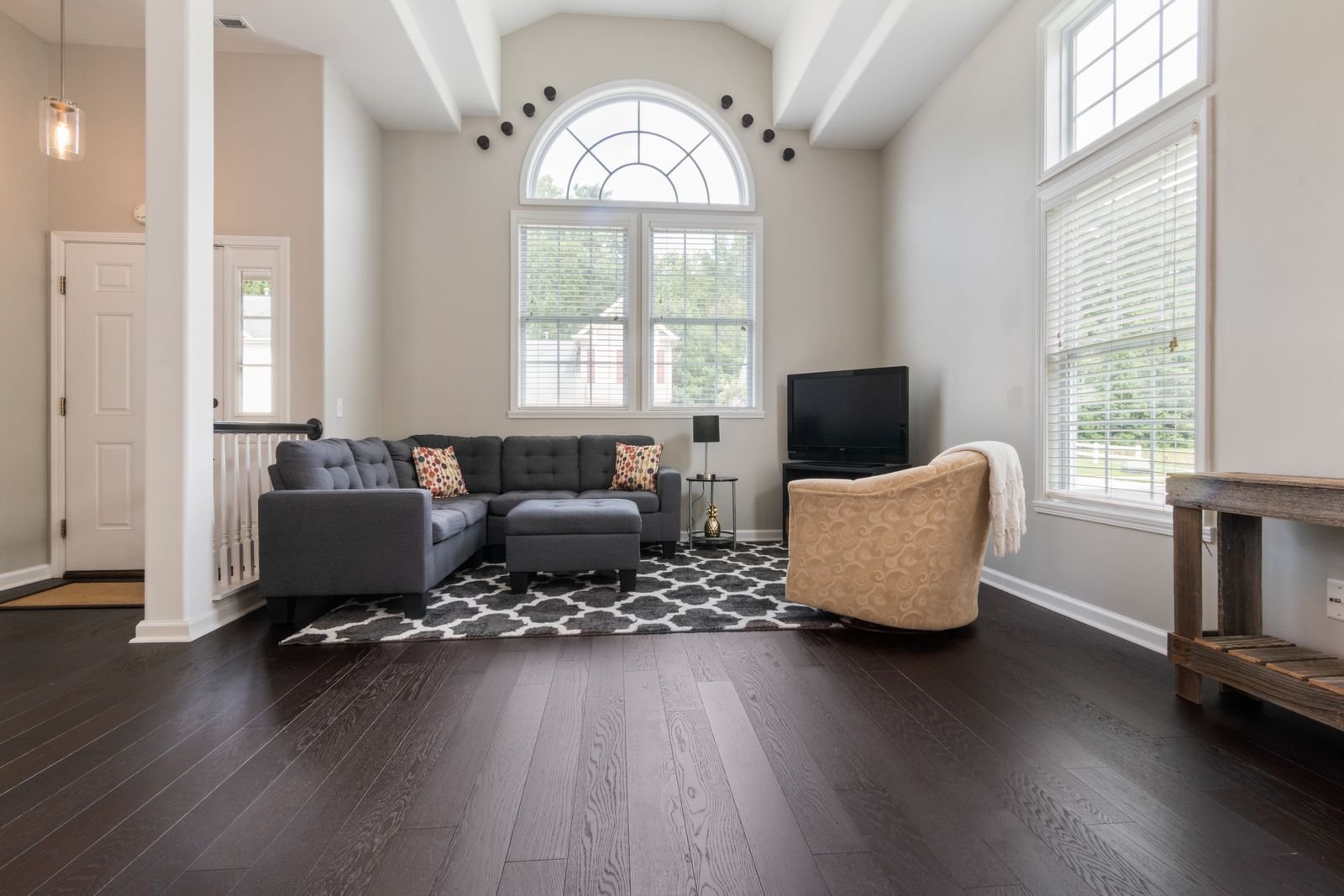
That means ceiling height matters. A 300-square-foot room with an 8-foot ceiling contains about 2,400 cubic feet of air. The same 300-square-foot floor area under a 12-foot ceiling contains 3,600 cubic feet—50 percent more air. A purifier sized only from floor area will therefore turn over the taller room more slowly.
EPA explicitly tells buyers with ceilings above 8 feet to consider a purifier rated for a larger area. This is one of the most common reasons a nominally “correct-size” purifier can feel underpowered in a loft, vaulted bedroom or open-plan living area.
An open floor plan should be sized as one connected air space
Putting a purifier beside the sofa does not create an invisible 300-square-foot bubble around it. If the living room opens directly into the kitchen and dining area, air moves through the connected space. EPA recommends considering the entire area the purifier is expected to serve.
This is where a small bedroom purifier often gets asked to do an impossible job. A 250-square-foot living room may actually be part of a 700-square-foot open plan. If there are no doors separating those spaces, size for the connected volume—or use more than one purifier where placement and airflow make that more practical.
The opposite is also true. One very large purifier in a hallway does not reliably substitute for purifiers inside several closed bedrooms. A closed door changes the air path. Buy around the rooms where you actually need particle removal, not the total square footage of the home.
Higher CADR is useful, but only if you will tolerate the fan speed
CADR is usually reported at maximum fan speed. That matters because the purifier that looks perfect on paper may be too loud for the way you intend to use it. If a bedroom unit only meets your target CADR on a setting you switch off at midnight, its effective overnight performance is lower than the spec sheet suggests.
Oversizing can give you useful headroom: a larger purifier may meet your real need at a lower, quieter setting. But do not assume the low-speed CADR is a fixed percentage of the high-speed number unless the manufacturer publishes airflow data for each setting.
If sleep noise is one of your main constraints, BestByNeed has a short example in An Air Purifier That Gets Quiet Enough for Sleep. The broader lesson is more important than the model: the purifier has to remain running at a useful airflow level to deliver the benefit you bought it for.
HEPA efficiency and CADR answer different questions
A HEPA label describes filter efficiency under a defined test. CADR describes how much cleaned air the whole purifier delivers. Those are related, but they are not interchangeable.
A highly efficient filter behind weak airflow can move less clean air through the room than a system with more airflow. Conversely, a high-CADR purifier is useful for particles only if the filtration system actually removes the particle sizes you care about. This is why buying by the word “HEPA” alone is not enough for room sizing.
For particle problems such as dust, pollen, smoke and airborne pet dander, compare CADR and room volume first. Then look at the filter design, replacement cost, noise and energy use as ownership variables.
CADR does not tell you how well a purifier handles gases and odors
Standard smoke, dust and pollen CADR values are particle metrics. They do not measure the capacity of an activated-carbon layer to adsorb VOCs or odors. EPA notes that particle filters and gas-removal filters solve different problems, and that meaningful gas removal generally depends on having enough sorbent material.
This matters because a purifier can be correctly sized for PM2.5 and still disappoint someone whose main concern is cooking odor, solvent fumes or other gases. When gas removal is the priority, carbon quantity and media design deserve separate scrutiny. Do not let a large CADR number answer a question it was never designed to answer.
Wildfire smoke is a case where extra capacity is reasonable
AHAM’s normal rule uses smoke CADR at least two-thirds of room area, but its wildfire guidance is more conservative: for heavily smoke-affected conditions, it recommends smoke CADR roughly equal to the room area in square feet. EPA’s cleaner-air-room guidance similarly emphasizes using a properly sized purifier and running it continuously at the highest practical setting during smoke events.
For a 300-square-foot cleaner-air room, that can push the target from around 200 CFM toward 300 CFM. The point is not to buy the biggest machine available. It is to match capacity to the pollution load and the room you are actually trying to protect.
A practical room-sizing sequence
- Measure the connected room area. Include open dining or kitchen space if there is no meaningful separation.
- Check ceiling height. Eight feet is the common baseline; taller rooms need more airflow for the same turnover rate.
- Use smoke CADR as the particle-sizing anchor. Start around two-thirds of the room area for ordinary use.
- Decide whether your situation needs more headroom. Wildfire smoke, very high ceilings or a desire to run quieter settings can justify stepping up.
- Check noise at the speed you will actually use. Maximum CADR is not helpful if that setting is routinely turned down.
- Separate particle cleaning from gas removal. CADR does not tell you carbon capacity.
- Confirm filter cost and availability. A well-sized purifier only stays useful if you keep the filters maintained.
If you are building a shortlist, use the BestByNeed Finder and include the room dimensions, ceiling height, main pollutant concern and acceptable noise level. You can also browse the Indoor Air & Climate category as this cluster grows, or return to the Buying Guides library for other decision-first guides.
Buy enough clean-air delivery for the room volume—not the biggest square-foot claim on the box.
The most useful air-purifier sizing number is not “covers up to 2,000 square feet.” It is the CADR tied to the turnover rate you want in the space you actually have. Start with smoke CADR, account for ceiling height and connected rooms, then choose a machine you can tolerate running. That approach makes Blueair’s 439-square-foot figure, Levoit’s 388-square-foot figure and their much larger one-hour coverage claims understandable instead of contradictory.
Key references checked for this guide: U.S. EPA Guide to Air Cleaners in the Home, AHAM air-filtration standards and 2/3 rule, AHAM wildfire-smoke guidance, Blueair Blue Pure 311i Max specifications, and Levoit Vital 200S-P specifications. Featured photo: Tobi on Pexels.