An automatic litter box can have excellent sensors, a polished app and a large waste drawer and still be the wrong machine for your cat. One of the most important choices happens before any of those features: should the toileting area be open-top or enclosed?
That sounds like a simple preference question, but the design changes how a cat enters, turns, watches the room, kicks litter, exits and reacts to movement. It also changes what you live with: litter tracking, odor containment, cleaning access and the amount of floor space around the machine.
Disclosure: BestByNeed may earn a commission from qualifying purchases made through some links on this page. Affiliate commission does not affect our recommendation scores or the product facts we use.
The short answer
There is no universal winner. An open-top automatic litter box usually gives the cat more visual openness and headroom, and can be easier for a large or enclosure-sensitive cat to accept. An enclosed automatic litter box can do a better job of controlling scatter and creating a contained waste-and-litter zone, but the entrance and usable interior dimensions matter much more than the outside size of the machine.
Do not assume that “open” automatically means easy access, or that “enclosed” automatically means better odor control. Current products show why. The Neakasa M1 Plus is open-top but BestByNeed records an entry step height of 35.2 cm. The PETKIT PuraMax 2 is enclosed yet has a 20 cm entry step. Meanwhile, both open and enclosed designs can use sealed waste drawers and dedicated odor-control systems.
If you have not already worked through size, sensor limits, litter compatibility and cleaning access, start with our broader automatic litter box buying guide. Enclosure style should be one decision inside that process, not a shortcut around it.
Cats do not appear to agree on covered versus uncovered boxes
It is tempting to turn this into a rule about what cats “naturally prefer,” but the evidence is more nuanced. A published study comparing covered and uncovered litter boxes offered both styles to 28 cats. At the group level, researchers found no significant preference for one style over the other. A small number of individual cats did show a clear preference, split between covered and uncovered boxes.
That study involved conventional litter boxes rather than self-cleaning machines, so it does not settle the automatic-litter-box question. It does make one point useful: individual acceptance matters more than a blanket rule. The motor, rotating drum, entry geometry and height of an automatic box add variables that a basic covered tray does not have.
Box size also deserves separate attention. A newer study found that cats preferred larger litter boxes in its test setting. That should not be converted into a universal minimum dimension for every automatic machine, but it reinforces the reason we focus on usable interior room, not just whether a cat technically fits through the entrance.
What an open-top design actually changes
The biggest advantage is not that the machine looks more like a traditional litter tray. It is that the cat does not enter a closed globe before eliminating. The head and upper body remain visually connected to the room, which can matter for a cat that dislikes covered boxes or wants to look around before settling.
The current Neakasa M1 Plus illustrates this approach. BestByNeed records its enclosure design as open-top and its cleaning mechanism as an open-top rotating sifter. Neakasa also markets the current M1 line around unobstructed space and easier adaptation for cats that are reluctant to enter a covered box. The PETLIBRO Luma takes a similar open-top approach while adding a camera and health-monitoring features.
But open-top should not be confused with low-entry. The cat may still need to step or climb into a raised litter bed. That matters for seniors, cats with arthritis or other mobility limitations, and small cats. Feline veterinary guidance for cats with chronic pain specifically recommends easy-to-access, low-entry litter boxes where mobility is an issue.
Open designs can also expose more of the digging area to the room. If your cat launches litter backward or over the side, you may need a larger mat, a fence or a high-pee guard. Neakasa, for example, sells separate anti-scatter and high-guard accessories for the M1 family. That does not make open-top a poor design; it means you should judge the whole litter zone, not only the machine footprint.
What an enclosed design actually changes
An enclosed automatic box creates a more controlled path into and out of the litter area. That can help with tracking and scatter when the entrance, tunnel or walkway is designed to catch litter before the cat reaches the floor.
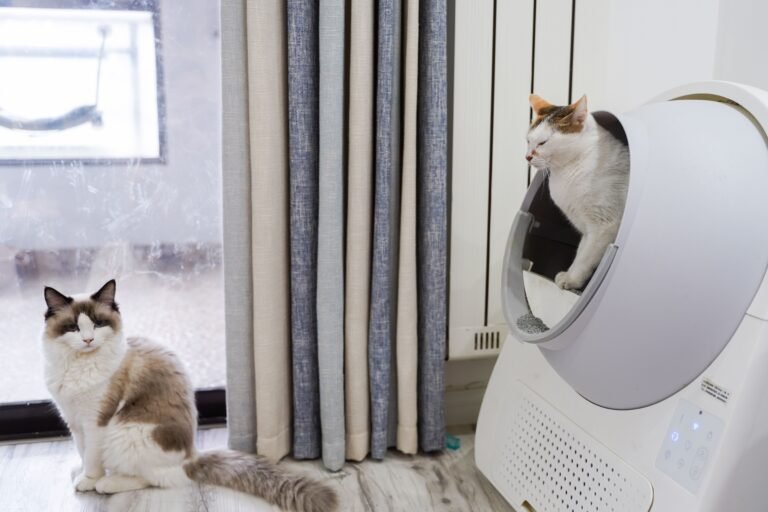
The PetSnowy SNOW+, for example, combines an enclosed structure with a curved anti-tracking walkway and a sealed waste system. PetSnowy also uses the enclosure as part of its odor-management design. The PETKIT PuraMax 2 uses a front-entry enclosed drum with a relatively low recorded entry step, while the Litter-Robot 4 uses a large front opening into a globe.
The trade-off is that a doorway measurement only tells you how the cat gets inside. It does not tell you whether the cat can stand, turn, dig and position its tail comfortably once there. Whisker lists the Litter-Robot 4 entryway at 15.75 by 15.75 inches, but its internal globe dimensions are different again. That is why our guide for large cats and automatic litter boxes treats doorway size and usable interior room as separate questions.
For an enclosure-sensitive cat, a tunnel or globe can also be a behavioral hurdle even when the physical dimensions are generous. If your cat already avoids covered conventional boxes, buying a more expensive enclosed robot does not remove that history.
Odor control depends more on waste handling than on the roof
One of the easiest mistakes is assuming an enclosed toilet area automatically solves odor while an open-top box cannot. In practice, the most important odor event happens after the cat leaves: how quickly waste is separated, where it is stored, how well that container seals and how often you empty it.
PetSnowy builds its current SNOW+ around an enclosed body, a deodorizing system and an auto-sealing waste bin. That is a strong example of enclosure being used as part of a larger odor-control strategy. But open-top machines can still isolate waste effectively. BestByNeed records a waste-drawer door seal for the Neakasa M1 Plus, while the PETLIBRO Luma combines an 11 L sealed drawer with active-carbon odor control.
So when odor is your priority, compare the waste path and drawer first. “Open versus enclosed” is only one part of the answer.
Safety is not an enclosure-style feature
Neither design should get a safety pass because of its shape. Automatic machines need to know when a cat is present, delay cleaning appropriately and stop if the cat re-enters or interrupts a cycle.
Different products use different combinations of weight, infrared, radar, motion and anti-pinch systems. Minimum detectable cat weight also varies by model. If you have a kitten or a very light cat, the exact manufacturer instructions matter more than whether the top is open.
This is also why BestByNeed separates product facts such as automatic pause on cat detection, anti-pinch design and minimum cat weight from the enclosure attribute. They answer different buying questions.
Which design makes more sense for your situation?
Lean toward open-top when your cat dislikes covered boxes, is large through the shoulders or body, wants visual awareness of the room, or simply seems more comfortable with fewer walls around the litter bed. Then check entry height carefully, because an open top does not guarantee an easy step-in.
Lean toward enclosed when litter scatter is one of your biggest frustrations, you value an integrated walkway or contained litter zone, and your cat already uses covered boxes comfortably. Then measure the doorway and interior rather than trusting the product’s outside dimensions.
For a senior or mobility-limited cat, I would make access geometry the deciding factor before enclosure style. A low step into an enclosed machine can be easier than a high climb into an open one. Conversely, an open machine with a well-designed ramp may be easier than a globe with a doorway the cat must climb through.
For a multi-cat household, do not assume every cat will make the same choice. Our guide to automatic litter boxes for multiple cats explains why keeping an alternative box during the transition can reveal whether one cat is being excluded by design, location or social pressure.
A better way to shop: compare the trade-off, not the label
Instead of filtering products into “open good” and “enclosed good,” compare the attributes that change daily life:
- Access: floor-to-entry height, step or ramp options, doorway width and height.
- Usable room: where the cat actually stands and turns, not the outside dimensions.
- Scatter control: wall height, fence, tunnel, walkway and mat design.
- Waste containment: drawer capacity, sealing method and emptying process.
- Cleaning: how easily the litter-contact surfaces can be removed and washed.
- Safety: detection methods, minimum cat weight, cycle delay and re-entry behavior.
This is exactly the kind of decision BestByNeed is built to separate. The Neakasa M1 Plus and PETLIBRO Luma show how open-top designs can pair generous exposure with automatic waste handling. The PETKIT PuraMax 2 and PetSnowy SNOW+ show two different enclosed strategies: one focused on a front-entry drum, the other on a contained walkway and odor-management path.
None of those design philosophies is universally better. The useful question is which compromise fits your cat and your home.
Before you buy
If you are comparing specific models, use the BestByNeed Finder to start from the constraints that matter to you rather than from brand popularity. For automatic litter boxes, that may mean cat weight, entry height, enclosure design, waste capacity, litter compatibility, offline operation or the safety features you consider non-negotiable.
And if your cat has mobility problems, persistent litter-box avoidance, house-soiling or a sudden change in toileting behavior, treat that as more than a shopping problem. A veterinarian can help rule out pain or medical causes before a new box becomes the attempted solution.